
14 vs 16 vs 18 Years of Education in Pakistan: HEC Equivalence and Job Eligibility
Compare 14, 16 and 18 years of education in Pakistan, HEC equivalence, ADP, BS and MS qualifications, and how to check government job eligibility.
Share this post
September series edition: 9 September 2026. Sources checked on 9 September 2026. This guide explains common qualification levels; HEC and the recruiting authority determine individual equivalence and eligibility.
What do 14, 16 and 18 years of education mean in Pakistan?
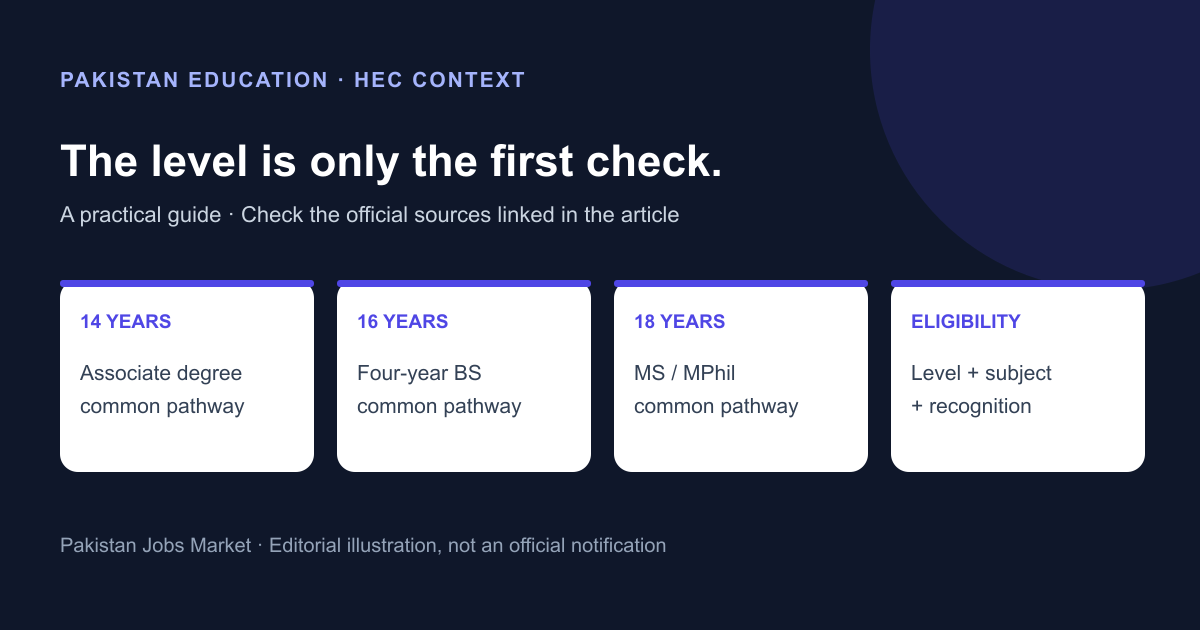
The phrase 14 vs 16 vs 18 years education Pakistan describes commonly used qualification levels, not simply the number of calendar years a person attended classes. A recognized two-year associate degree after intermediate generally corresponds to fourteen years; a four-year bachelor's after intermediate generally corresponds to sixteen; and an appropriate MS or MPhil after sixteen-year education commonly corresponds to eighteen. The exact qualification, institution, programme and official equivalence still matter.
For government jobs, matching the education level is only one part of eligibility. The advertisement may also specify the discipline, division or grade, professional registration, experience and recognition requirements. A higher qualification in an unrelated field does not automatically satisfy those conditions. This article explains the usual pathways and gives a practical method for checking an advertisement without overstating what your degree proves.
A quick comparison of the three levels
| Common level | Typical pathway | What must still be checked |
|---|---|---|
| 14 years | Recognized two-year associate degree after twelve-year schooling; legacy BA/BSc pathways | Programme recognition, admission period and specific equivalence |
| 16 years | Recognized four-year BS or bachelor's after intermediate; appropriate legacy master's pathway | Degree discipline, duration, awarding institution and advertised wording |
| 18 years | Appropriate recognized MS/MPhil after sixteen-year education | Programme standards, recognition and field-specific eligibility |
HEC's local-degree equivalence FAQs explain that a qualifying two-year associate degree is generally equivalent to the old BA/BSc fourteen-year level, and that a qualifying four-year bachelor's is generally equivalent to the old MA/MSc sixteen-year level in its own field. HEC also emphasizes individual assessment where an equivalence decision is required.
Why calendar years are not the same as qualification level
If a four-year degree takes someone five calendar years because of a break or repeated semester, that does not automatically make it a seventeen-year qualification. Conversely, completing a recognized programme through an approved pathway does not mean its level can be dismissed by counting only the months physically spent on campus. The qualification is assessed through its recognized structure and standards, not an improvised personal timeline.
This distinction is especially important for transfer students, part-time study, bridging routes and qualifications from abroad. Keep the admission record, transcript and award details. If a form asks for degree duration, answer that question as instructed; if it asks for education level, do not substitute a different number simply because your personal study period was longer. Ask the issuing institution or HEC when the correct classification is unclear.
A useful habit is to record the full degree title exactly as awarded, followed by the university and completion date. Do not shorten it into a different qualification because you believe the two are equivalent. You can provide an official equivalence document where needed while retaining the actual award name. That keeps your CV and application consistent with the evidence.
What does a fourteen-year qualification usually mean?
A recognized associate degree is a common current pathway discussed at the fourteen-year level. Older BA and BSc qualifications also appear in advertisements and equivalence discussions. However, the existence of a legacy qualification does not mean every newly offered programme using an old title is valid. Check recognition and the rules applicable to the programme and admission period before enrolling or relying on it.
For a job application, read whether the notice accepts an associate degree, a bachelor's of a stated duration, or a particular subject. A general fourteen-year qualification may not meet a post requiring a four-year bachelor's in a named discipline. If the advertisement uses older terminology, seek clarification from the recruiting authority instead of assuming that every interpretation favorable to you is accepted.
For further study, ask the receiving university about its recognized progression route and any required bridging work. Do not assume that every associate degree provides automatic entry into the same semester of every bachelor's programme. Admission and credit-transfer decisions need the university's approved policy and the relationship between the previous and new fields of study.
What counts as sixteen-year education?
A recognized four-year bachelor's after intermediate is the familiar route. HEC's FAQ explains its general comparison with the old master's level within the relevant specialization. That does not mean a BS graduate should rename the award “MA” on an application. Enter the qualification actually earned and use the official equivalence route if the recruiting authority requires proof of the comparison.
Some advertisements say “master's or bachelor's, sixteen years of education” and then list acceptable subjects. Read the complete sentence. A degree with the right duration but an unlisted discipline may still require clarification or may not qualify. The level and subject conditions are separate. A transcript can help explain your field, but it does not allow you to invent an equivalence that the authority has not accepted.
When comparing programmes before admission, focus on the recognized award and what it enables you to apply for. Marketing language such as internationally accepted or equivalent to a master's is not sufficient evidence. Ask for the exact HEC-recognized programme, campus and award title. A clear answer at enrollment is much more valuable than trying to resolve recognition after graduation.
What does eighteen-year education mean?
MS and MPhil qualifications commonly appear at this level after a sixteen-year entry qualification, subject to the relevant standards and recognition. HEC's degree-attestation document categories show why labels alone need care: its classification recognizes variation in the stated years attached to qualifications. Do not treat a short course or a programme merely called “master” as automatically equivalent to an MS/MPhil.
A higher qualification can support research, specialist knowledge and certain career pathways, but it does not erase every earlier requirement. A post may require a specified bachelor's discipline, professional registration or experience after a particular qualification. An MS in another subject does not automatically replace those conditions. Use the wording in the recruitment notice as the starting point.
For someone considering postgraduate study mainly to improve job eligibility, review several actual advertisements first. Identify whether the desired roles require eighteen years, prefer it, or primarily ask for experience and professional skills. This exercise does not predict future hiring, but it helps prevent choosing a programme based on a vague belief that more years always solve every eligibility problem.
Recognition, attestation and equivalence are different checks
Recognition asks whether the institution and qualification meet the relevant recognition framework. Attestation concerns the verification process for educational documents. Equivalence addresses how a qualification is assessed against another level or requirement. These processes are related, but one should not be described as automatically settling all the others. Read the instructions for the service you actually need.
The Pakistan Qualification Register provides information about recognized qualifications and providers. Check the programme and campus, not only the university name on an advertisement. A familiar university name should not be treated as permission to ignore the recognition of a specific programme or teaching location.
If you cannot find a qualification, contact the institution and HEC through their official channels before drawing a final conclusion. Save the response. Avoid relying solely on an agent, an advertisement or a screenshot without a verifiable source. For a professional field, also establish whether the relevant professional body's requirements apply to the programme and to the job you want.
How to read a government job's education requirement
Break the requirement into separate parts: qualification title or level, subject, minimum division or grade, recognition, and any additional certificate or registration. Then compare your documents with each part. If a requirement says sixteen years in a listed field, meeting sixteen years in any subject is not enough. If it says equivalent, identify who is authorized to determine that equivalence.
Consider a hypothetical advertisement requiring a four-year bachelor's in computer science or an accepted equivalent. An applicant with a recognized associate degree has a different qualification level and should not assume that work experience automatically replaces the degree requirement. Another applicant with a four-year degree in an unrelated field should not assume the duration alone resolves the subject requirement. Both cases require the actual recruitment wording, not a generic online chart.
Conversely, do not reject yourself solely because your award title is worded differently from an old advertisement. Where an official equivalence route exists, gather the relevant proof and seek clarification. The careful approach avoids both unsupported applications and unnecessary self-exclusion. It is especially useful for older qualifications, foreign awards and interdisciplinary programmes.
CGPA, percentage and division should not be invented
A degree level does not tell you whether you meet a minimum grade requirement. If the advertisement asks for a division or percentage and your transcript gives a CGPA, use the university's authorized conversion or the recruiting authority's instructions. Do not multiply a CGPA by a convenient number and call the result official. Different institutions can use different assessment rules.
The CGPA Calculator can help with academic planning and checking entered semester information. It does not issue a certified percentage conversion, alter a transcript or decide a recruitment equivalence. For an application, rely on the formal record and any required conversion certificate. Keep your planning estimates clearly labelled so they are not accidentally submitted as certified results.
If your degree is not yet complete, distinguish completed coursework from an awarded qualification. An expected graduation date on a CV is useful information, but it is not proof that a qualification was held by an advertisement's cutoff date. Check whether results awaited are accepted and what evidence is required. Do not use an anticipated award as though it had already been issued.
Foreign degrees and unusual pathways
Foreign qualifications often use titles that do not map neatly to Pakistani terminology. Do not determine equivalence by translating the word bachelor or master alone. The awarding institution, entry requirements, programme structure and official assessment can matter. Use HEC's relevant equivalence service and the recruiting authority's instructions rather than relying on an informal comparison from a student forum.
Keep the complete transcript and award documents, plus any information requested through the official process. If the degree was delivered through a partner institution or across multiple locations, be ready to explain that accurately. Do not conceal the delivery arrangement because it makes the application look simpler. A complete and truthful record is more likely to allow a clear assessment.
Likewise, professional, religious and specialized qualifications may have their own equivalence provisions and conditions. This article's three-row overview is not a substitute for those provisions. An individual certificate can state a specific level or purpose, and its wording should be followed carefully. Avoid generalizing one person's equivalence decision to every qualification with a similar name.
A document checklist for applicants
- The degree or provisional award document requested by the recruiter.
- A complete transcript showing the programme and result.
- Recognition information for the institution, campus and programme where relevant.
- An official equivalence certificate if the case requires one.
- An authorized grade conversion where the advertisement requires it.
- Any professional registration or additional certificate specified in the notice.
- The original advertisement and any corrigendum for the particular case.
Organize these records before the deadline. Do not wait until interview to discover that a transcript is incomplete or the name differs across documents. If there is a genuine discrepancy, ask the issuing authority about correction. Keep scans readable and use the requested format, but never edit the substantive content of an official certificate to make it appear consistent.
How to describe qualifications on your CV
Use the exact award title, awarding institution, field and completion date. Add a concise equivalence note only when it is supported and relevant. For example, an official assessment can be mentioned without replacing the actual degree name. Avoid describing a bachelor's as an MPhil merely because you spent extra years completing it or took additional unrelated courses afterward.
The Resume Builder can help present this information consistently. Before downloading, compare every education entry with the transcript. A neat layout improves readability, but accuracy remains the priority. If you include an expected qualification, label it as expected and do not let the design imply that it has already been awarded.
Frequently asked questions
Is ADP generally fourteen-year education?
A qualifying recognized two-year associate degree after intermediate is generally discussed at that level in HEC's local equivalence guidance. The exact programme and any required individual assessment still matter.
Is a four-year BS the same award as an MA?
No. HEC describes a general level comparison in the relevant field, but your award title remains the one issued by the university. Use an equivalence document where required rather than renaming the degree.
Does an MS guarantee eligibility for every sixteen-year job?
No. Subject, prior qualification, recognition, grades and other advertised conditions still apply. A higher level alone is not a universal substitute for a specific requirement.
Can extra short courses raise my education level?
Do not add unrelated course durations to create a new formal level. List the courses honestly as additional training and rely on recognized qualifications and official equivalence for the education requirement.
Official sources and next step
Use HEC's local-equivalence FAQs, attestation categories and Qualification Register linked above. The Undergraduate Education Policy V1.1 provides further context for associate and bachelor's programmes. The comparisons and applicant checklists are editorial guidance, not individual equivalence certificates. Before paying an application fee or enrolling in a programme, resolve any uncertainty with HEC, the institution or the recruiting authority responsible for the decision.