
BPS Salary Chart 2026 Pakistan: BPS-1 to BPS-22, Allowances and Gross Pay
Read the federal BPS-1 to BPS-22 salary chart for 2026, understand basic versus gross pay, and check allowances with official Finance Division sources.
Share this post
September series edition: 3 September 2026. Official sources checked on 9 September 2026. This guide covers the federal schedule, not a universal payslip for every province or organization.
What is the BPS salary chart for 2026 in Pakistan?
The BPS salary chart 2026 Pakistan notification introduces revised federal basic pay scales effective from 1 July 2026. Basic pay starts at Rs 16,280 for BPS-1 and Rs 146,770 for BPS-22. These are starting basic-pay amounts, not gross salary or take-home pay. Your grade, approved stage, applicable allowances and deductions determine the actual monthly result.
That distinction is the most useful starting point for anyone comparing government jobs. A chart can be numerically correct and still be misleading if it describes basic pay as total salary. This article separates the official scale from a practical payroll worksheet, shows how to read increments, and explains why a single gross figure for each grade is not reliable without a stated employee profile.
Federal BPS-1 to BPS-22 basic pay table
All figures are monthly Pakistani rupees. “Increment” means the notified step within that scale; it is not a percentage to apply to gross salary. The maximum is the top of the published scale, not the amount every employee in that grade receives.
| Grade | Minimum basic | Increment | Maximum basic |
|---|---|---|---|
| BPS-1 | 16,280 | 520 | 31,880 |
| BPS-2 | 16,600 | 590 | 34,300 |
| BPS-3 | 17,130 | 700 | 38,130 |
| BPS-4 | 17,650 | 800 | 41,650 |
| BPS-5 | 18,300 | 910 | 45,600 |
| BPS-6 | 18,930 | 1,010 | 49,230 |
| BPS-7 | 19,590 | 1,100 | 52,590 |
| BPS-8 | 20,290 | 1,210 | 56,590 |
| BPS-9 | 20,990 | 1,310 | 60,290 |
| BPS-10 | 21,680 | 1,430 | 64,580 |
| BPS-11 | 22,410 | 1,580 | 69,810 |
| BPS-12 | 23,750 | 1,720 | 75,350 |
| BPS-13 | 25,420 | 1,880 | 81,820 |
| BPS-14 | 27,060 | 2,090 | 89,760 |
| BPS-15 | 28,730 | 2,380 | 100,130 |
| BPS-16 | 33,720 | 2,720 | 115,320 |
| BPS-17 | 54,140 | 4,110 | 136,340 |
| BPS-18 | 68,330 | 5,120 | 170,730 |
| BPS-19 | 105,510 | 5,450 | 214,510 |
| BPS-20 | 123,090 | 8,040 | 235,650 |
| BPS-21 | 136,680 | 8,920 | 261,560 |
| BPS-22 | 146,770 | 10,470 | 293,350 |
Official source: Finance Division, revision of federal basic pay scales and allowances, 21 July 2026, particularly paragraph 11. The notification also explains the treatment of earlier relief allowances and pay fixation. Read those provisions before comparing an old payslip with the revised scale.
What changed in the 2026 federal notification?
The memorandum replaces the 2022 basic scales for the covered federal employees, merges the specified 2022 and 2025 ad-hoc relief components, and introduces a seven-percent 2026 relief allowance on running basic pay under the revised scale. Existing employees' fixation follows corresponding stages, subject to the notification. It also preserves the annual increment date of 1 December under the existing conditions.
The practical risk is double counting. If an allowance has been merged into basic pay and ceases separately, keeping it in your spreadsheet as an additional recurring line inflates the result. Do not simply take an old gross salary, add the difference between the two minimum scales, and then add every percentage mentioned in a budget headline. Rebuild the calculation from a confirmed fixation and applicable component list.
Another risk is assuming that every allowance rises whenever basic pay changes. The notification addresses frozen allowances as well. A payroll component can depend on an older basis or a fixed authorized amount. Write the calculation basis beside each allowance instead of using one global formula. That small habit makes a worksheet easier to audit and makes errors visible when a later circular changes only one component.
How to calculate your stage within a grade
For an ordinary stage shown in the schedule, the arithmetic is minimum basic pay plus the number of approved increments multiplied by the listed increment. For example, BPS-16 begins at Rs 33,720. Three increments of Rs 2,720 produce Rs 41,880. This is a scale example, not an instruction to award yourself three increments because you have three years of any kind of work experience.
Your recognized stage comes from appointment and pay-fixation records. Promotions, prior qualifying service, personal pay and other circumstances may require an accounts-office decision rather than a simple fresh-entry calculation. If you are an existing employee, compare the actual stage shown in the fixation statement. If you are a new applicant, ask whether the offer assumes the minimum or an expressly approved higher starting point.
Notice that grades have different stage counts. The table's minimum and maximum should be checked together with its increment. Do not extend a formula beyond the maximum and label the result ordinary basic pay. If your payslip includes an amount beyond the scale through a separate rule, identify that component properly rather than changing the published maximum to force the numbers to match.
Basic pay versus gross salary versus net salary
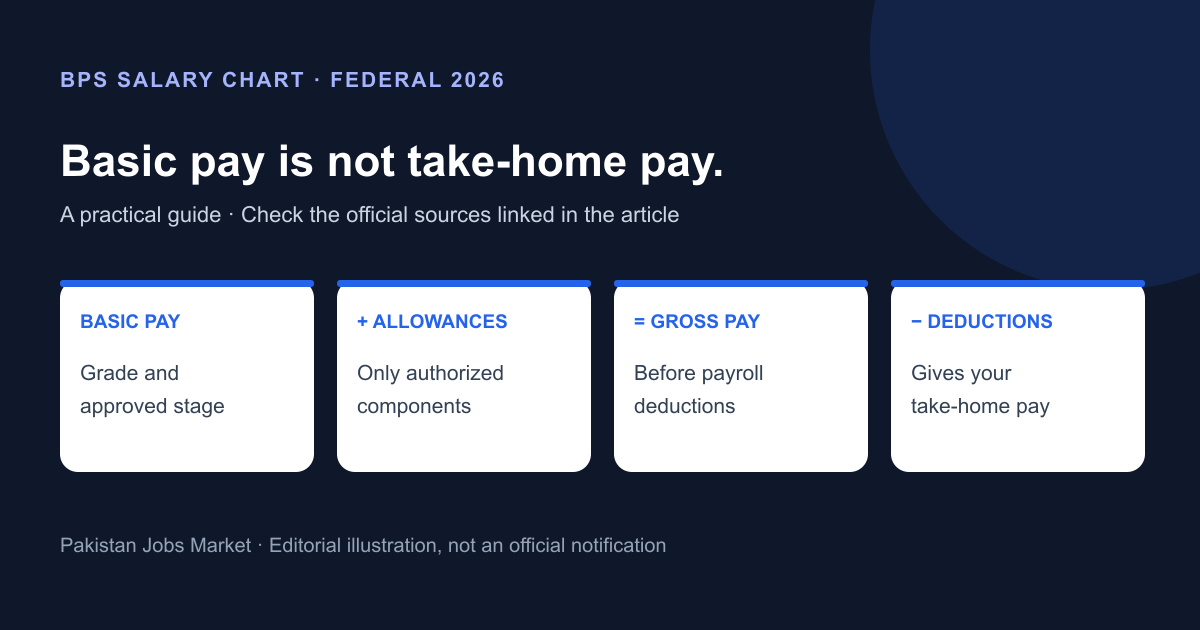
Basic pay is the amount established through your grade and fixation. Gross salary is basic pay plus the salary components actually admissible to you. Net salary is the amount remaining after applicable deductions and adjustments. A job advertisement may state only the grade because it cannot describe every future employee's payroll position. That is not a reason to present a guessed net salary as an official figure.
Suppose, purely as an illustration, an employee has Rs 41,880 basic pay, Rs 20,000 in verified additions, and Rs 7,000 in verified deductions. Gross pay would be Rs 61,880 and net pay Rs 54,880. The additions and deductions here are invented teaching inputs, not recommended allowance rates. Replace them with the amounts authorized for the employee before using the worksheet to make a financial decision.
A month containing arrears, a recovery or a partial joining period may be atypical. When estimating a sustainable household budget, separate normal recurring salary from one-off movements. The largest bank transfer in the year is not necessarily the best measure of regular income. Keep the payslip and bank transfer together so that any difference can be traced to a specific period or adjustment.
How to review allowances without guessing
| Component | Question to ask payroll |
|---|---|
| House rent | Which authorized amount or frozen basis applies, and does accommodation affect it? |
| Conveyance | Which current notification and employee category apply? |
| Medical or health-related allowance | What eligibility and rate are authorized for this appointment? |
| Ad-hoc relief | Which components continue, which are merged, and what is each calculation basis? |
| Special or departmental allowance | Does the post actually qualify under the relevant order? |
The separate 2026 conveyance allowance notification illustrates why one document should not be treated as the entire salary system. Check the relevant order rather than copying a rate from an unrelated department's payslip. Eligibility, provision of facilities and the category of appointment can matter alongside the grade.
House rent is especially easy to misstate because readers often multiply a remembered percentage by the newest basic pay. Before doing that, establish the authorized basis and whether a freeze or other condition applies. The same caution applies to medical, disparity and special allowances. An allowance mentioned somewhere in government policy is not automatically payable to every federal employee, and provincial adoption is a separate question.
Why provincial salaries should not be copied from the federal chart
Pakistan has federal and provincial payroll authorities. A shared BPS label does not prove that all allowances or implementation dates are identical. An employee in Punjab, Sindh, Khyber Pakhtunkhwa or Balochistan should use the relevant provincial finance notification and departmental instructions. The federal table is useful context, but it is not a substitute for the order governing that employee.
Likewise, an autonomous body may follow its own adoption decision, service rules or contract package. Ask whether the organization has formally adopted a revision. A chart that combines federal basic pay with a provincial allowance and an autonomous body's benefit can look plausible while describing no real employee. Keep the jurisdiction visible at the top of every salary estimate you share.
When comparing two offers in different cities, calculate living costs separately from payroll. A higher salary may be offset by relocation, housing or travel costs. Those are personal budgeting considerations, not deductions from official basic pay. Distinguishing the two helps you understand both the employer's offer and what it means for your household without mixing legal entitlement with personal expenditure.
Deductions and pension arrangements
Tax, retirement contributions, recoveries and other authorized deductions can affect take-home pay. Do not assume two employees in the same grade have the same deductions. Their appointment history and individual circumstances may differ. Ask for a component-level explanation if a deduction is unfamiliar, particularly when a new retirement arrangement or arrears calculation appears for the first time.
Our federal contributory pension explainer describes the distinction between the scheme's contribution basis and gross salary. It is not safe to apply a retirement percentage to every allowance just because the allowance is paid monthly. For personal payroll treatment, the accounts office should identify the governing rule and the pensionable pay used in the calculation.
Similarly, use the correct tax year and annual context when estimating income tax. A monthly calculator can help with planning, but a final tax position may depend on the full year's records. Preserve salary certificates when changing jobs. If your payroll includes a tax adjustment, request the calculation instead of treating the difference as evidence that the basic scale itself is wrong.
A practical payslip audit in seven steps
- Confirm the employer and jurisdiction.
- Record the grade, scale year and approved stage.
- Recalculate ordinary basic pay from the table where that formula applies.
- List each allowance and its governing basis separately.
- Remove components that have ceased or been merged.
- Separate recurring deductions from arrears and one-off adjustments.
- Compare the resulting net figure with the bank transfer for the same period.
If the calculation still differs, send a focused query with the relevant payslip and fixation order. State which line you cannot reconcile and show your arithmetic. Avoid sending unnecessary personal documents or unredacted account details to public forums. A concise written query gives the accounts team a clear starting point and creates a record if a correction is required later.
Using salary information when applying for jobs
Salary research is most useful after confirming eligibility. A BPS grade alone does not identify the required degree, experience, domicile or age limit. Read the original advertisement carefully, then compare salary under the correct appointment conditions. The Government Salary Calculator can help explore supported schedules, but always check its source year and assumptions before using an estimate.
Prepare an offer-comparison sheet with salary, location, contract status, working responsibilities and confirmed benefits. Keep unknown items clearly marked as unknown. That is more honest than filling every box with an optimistic estimate. Before resigning from an existing position, obtain the new appointment conditions in writing and consider any notice-period obligations relevant to your circumstances.
Frequently asked questions
What is the starting BPS-17 basic pay in 2026?
The federal 2026 table lists Rs 54,140. That is basic pay at the minimum, not a universal gross or net salary. An employee's approved stage and applicable components must be added to understand the full payslip.
Can I use the maximum as my expected salary?
No. The maximum is the top of the scale. A new appointment normally needs its own starting fixation. Ask what stage is authorized rather than assuming that the grade's maximum is the offer.
Is a PPS package the same as BPS basic pay?
No. PPS project packages and regular BPS payroll are different arrangements. Compare their written conditions, not just the scale numbers. Adding regular allowances to a project lump sum without authority can materially overstate expected pay.
Does a pay revision mean every allowance rises?
No. Some components may be frozen, merged, replaced or subject to separate conditions. Check each line against the applicable notification and ask payroll for clarification where the basis is unclear.
Official references and responsible use
The table was visually checked against the Finance Division's 21 July 2026 memorandum. The worked examples are editorial arithmetic with explicitly stated assumptions. Consult the official circulars index for clarifications and later amendments, and your own finance department for the applicable jurisdiction. This article helps you ask better questions and check calculations; it does not issue pay-fixation authority or replace individual professional advice.