
Pakistan's New Pension Scheme in 2026: Eligibility, Contributions and How It Works
Understand Pakistan's federal contributory pension scheme, who it covers, employee and employer contributions, and what the 2026 implementation means.
Share this post
September series edition: 5 September 2026. Sources checked on 9 September 2026. This article explains the federal scheme; provincial schemes and individual cases require their own rules.
What is Pakistan's new pension scheme in 2026?
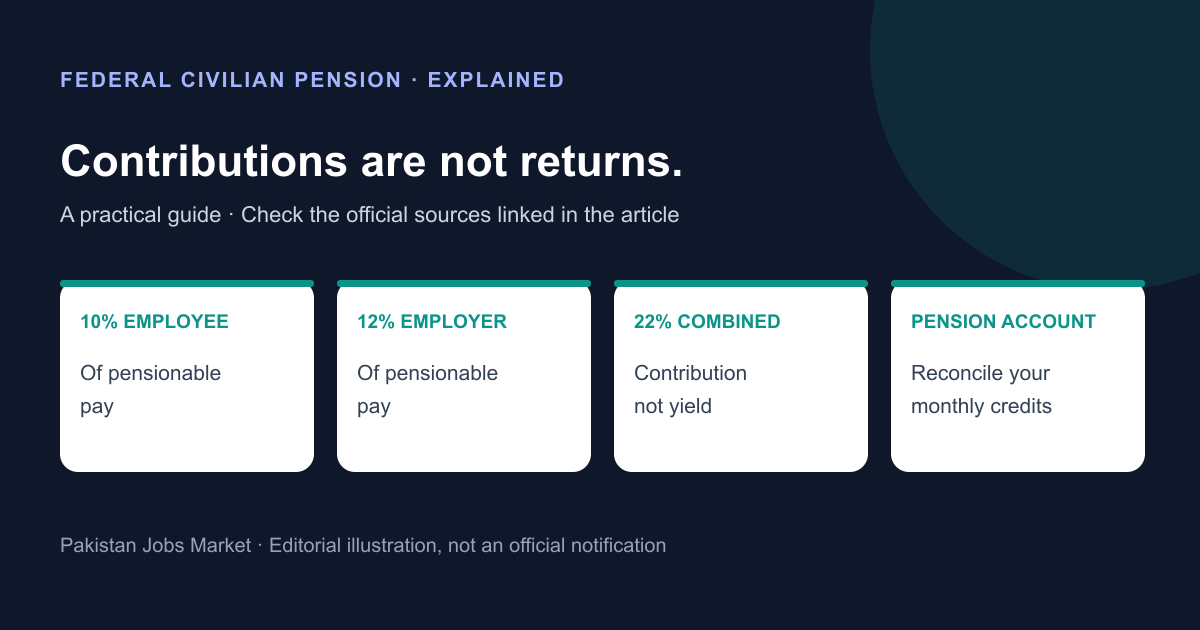
People searching for the new pension scheme Pakistan 2026 are usually asking about the federal Defined Contribution Pension Fund Scheme Rules, 2024 and their implementation. The covered civilian schedule specifies an employee contribution of ten percent and an employer contribution of twelve percent of pensionable pay. The combined twenty-two percent is a contribution rate, not a guaranteed investment return or a promised percentage of final salary at retirement.
The year in a search query can obscure the policy timeline. The rules are named for 2024, were notified through a 2025 statutory notification, and an August 2026 memorandum addresses implementation. Calling it simply a brand-new scheme for every Pakistani worker would be inaccurate. First identify whether your appointment is covered; only then examine the contribution calculation and account arrangements.
Who is covered, and who should not assume coverage?
The rules cover specified initial regular federal appointments, including civilians paid from defence estimates, on or after 1 July 2024. They also address civil armed forces, contractual employees on regular appointment, exclusions for certain existing regular employees subsequently appointed to other federal civil posts, and other categories. Armed forces provisions should not be replaced with an assumed civilian rate or date.
Read the employee definition in rule 2(g), not just a headline about “new employees.” A person moving between posts may have a different history from a first-time regular appointee. A contractual employee's regularization date can matter. If you are uncertain, give your department a dated appointment history and ask for a written classification. Do not decide coverage merely from your age, present grade or the month you first saw a deduction.
Official reference: Federal Government Defined Contribution Pension Fund Scheme Rules, 2024, circulated in October 2025. The employee definition appears in the attached Gazette text. This is the source for the legal scope, not a general statement that every government worker in Pakistan has been moved to the same arrangement.
What changed operationally in 2026?
The 11 August 2026 implementation memorandum says the scheme has entered its operational phase and assigns coordination and implementation work across the relevant federal offices. For employees, the practical questions are whether their records are complete, whether the pension account has been established through the authorized process, and whether payroll contributions can be reconciled with the account.
Implementation should not be confused with inventing a new entitlement from a press report. Keep the rule, the implementation instruction and your individual payroll record together. Each serves a different purpose: the rule defines the framework, the instruction organizes administration, and the payroll record shows what has actually happened for you. If one document is missing, ask the responsible office rather than filling the gap with an assumption.
For someone joining a covered post, this means pension paperwork deserves attention alongside the joining report and bank details. For an existing covered employee, it means checking whether deductions and employer contributions are visible and correctly attributed. A payslip deduction alone is not the same evidence as a reconciled pension account statement showing the corresponding credit.
How are the contributions calculated?
The civilian rates in the First Schedule are ten percent from the employee and twelve percent from the employer. The definition of pensionable pay uses running basic pay including personal pay, excluding other pay, allowances and perquisites. Do not apply twenty-two percent to gross salary and call the result your payroll deduction: the employer's share is separate from the employee's deduction.
| Illustrative pensionable pay | Employee 10% | Employer 12% | Combined contribution |
|---|---|---|---|
| Rs 40,000 | Rs 4,000 | Rs 4,800 | Rs 8,800 |
| Rs 60,000 | Rs 6,000 | Rs 7,200 | Rs 13,200 |
| Rs 100,000 | Rs 10,000 | Rs 12,000 | Rs 22,000 |
These examples are arithmetic, not individual payslip determinations. In the middle example, Rs 6,000 is the employee contribution and Rs 7,200 is the employer contribution. The Rs 13,200 total is not an additional amount available for monthly household spending. It is also not evidence that an investment balance must rise by exactly that amount after every possible fee, valuation movement or timing difference.
Before comparing your result with this table, confirm the pensionable-pay figure used by accounts. A total salary figure containing allowances is not interchangeable with that base. If contributions are being reconciled for an earlier period, ask for month-by-month workings. A single aggregate deduction is difficult to check without the dates and pay amounts underlying it.
Defined contribution versus a promised pension formula
In a defined-contribution arrangement, the contribution rules describe the amounts paid into the arrangement. The eventual account value depends on contributions and investment outcomes under its rules. That is conceptually different from treating a retirement payment as a fixed percentage of a final salary. The distinction matters when people compare old and new arrangements using a single monthly number.
A fair comparison would need a person's service history, contribution history, retirement date, applicable rules and assumptions about future outcomes. Those assumptions should be visible, not hidden inside a confident-looking estimate. This article does not forecast your retirement income or recommend a particular fund. For a personal decision, obtain regulated advice appropriate to your circumstances and verify the current official scheme documents.
Be cautious with viral examples promising a fixed amount after thirty years. Such examples can depend heavily on assumed returns, uninterrupted service and future pay increases. Small changes to those inputs can produce large differences over time. A useful illustration should label its assumptions and show uncertainty; it should not be presented as a government guarantee.
What to check in your account and payslip
Maintain a simple reconciliation with the salary month, pensionable pay, employee contribution, employer contribution, payment date and account reference. Compare that record with the official statement from the authorized manager. If a month is missing, report the specific period and amount. This is more actionable than asking whether your “pension is correct” without identifying the discrepancy.
Keep contribution amounts separate from investment valuation changes. A statement may show both cash flows and the value of units or holdings. Those are related but different measurements. If the balance does not equal the sum of contributions, request an explanation of valuation dates, charges and transactions before assuming a payroll error. Conversely, investment movement should not be used to dismiss an actually missing contribution.
Use official contact channels and avoid sharing account identifiers, CNIC images or salary records in public discussion groups. A legitimate request for correction should go to the relevant department or authorized provider. Retain a copy and reference number. Basic record keeping helps you resolve issues without exposing unnecessary personal information to strangers offering informal assistance.
Choosing an authorized provider and understanding risk
The scheme uses eligible pension fund managers under the governing framework. Check the Finance Division's current approved information rather than selecting a provider solely because an advertisement uses the word pension. Confirm the exact product and employer arrangement, then request the documents explaining its fees, allocation rules, reporting and complaint process. An ordinary investment product with similar branding may not be the required scheme account.
The rules include an allocation framework and a default allocation. Do not interpret “default” as a personalized recommendation or “lower risk” as a promise that every outcome is guaranteed. Ask the authorized provider to explain the choices available under the scheme and how restrictions apply. Avoid choosing allocations based only on the previous year's best-performing product.
For general regulatory context, consult the Securities and Exchange Commission of Pakistan. The practical question is not merely whether a financial company exists, but whether the specific arrangement is eligible under the scheme and the official employer agreement. Verify those details before submitting sensitive documents or transferring any money outside the prescribed payroll process.
Retirement, transfers and leaving service
The rules contain restrictions on withdrawals and address retirement and transfers. They do not make the account equivalent to an unrestricted savings wallet. The retirement provisions limit the immediate withdrawal and govern the remaining amount. Leaving employment before the normal retirement point has its own treatment; do not assume resignation unlocks the entire balance without conditions.
Before a resignation, transfer or retirement decision, obtain a written explanation of the rule applicable to that event. Ask about the required employer notification, the manager's process, any transfer route and the treatment of pending contributions. A general explainer cannot resolve every service history. The costs of acting on an incorrect assumption can be much larger than the time needed to get an official clarification.
Keep pension questions separate from notice-period, service-benefit and tax questions, even if they arise together. Different offices or professionals may be responsible for each. A checklist helps ensure that a response about one issue is not mistaken for clearance of all the others. Where a rule refers to later government instructions, confirm those instructions before acting.
Three situations that need careful classification
A first regular federal appointment after the relevant date
Collect the appointment order and joining details, then ask accounts to confirm scheme coverage and the contribution base. Do not postpone the question until retirement. Early reconciliation is easier because the number of salary periods is small and the relevant documents are readily available.
A long-serving employee taking another federal post
Provide the full earlier regular-service history. The rules contain an exclusion relevant to specified existing regular employees subsequently appointed to other federal civil posts. Do not treat the latest appointment date in isolation, and do not assume the exclusion applies without checking the exact conditions.
A contract employee later appointed regularly
Distinguish the initial contract from the regular appointment. The rules expressly address that transition. Ask which date is used and how any earlier period is treated. A service certificate saying you worked for several years is useful evidence, but it is not by itself a pension-coverage decision.
Questions to send your accounts office
- Am I covered under the employee definition, and which appointment record establishes that?
- What pensionable pay is used for my contribution?
- Where can I see both employee and employer amounts for each month?
- Which eligible manager and account details are recorded?
- How should I report a missing or incorrect contribution?
- What documentation is needed if I transfer, leave service or retire?
Attach only the records necessary to answer the question and use the department's prescribed channel. If you receive a verbal explanation, ask whether it can be confirmed in writing or linked to the relevant instruction. This is ordinary administrative diligence, not a challenge to the office. A clear record protects both the employee and the people processing the case.
How this affects a job-offer comparison
When comparing a new government offer, separate take-home salary from retirement contributions. Employer contributions may be part of the wider employment package, but they are not cash available for rent that month. Use the BPS basic-pay and allowances guide to understand the salary components before considering retirement arrangements.
Do not compare a project contract and a regular appointment by assuming identical retirement coverage. Ask each employer what is actually authorized. A carefully documented comparison can include confirmed monthly cash, contract duration and the applicable retirement scheme, while leaving uncertain benefits unpriced. This is more reliable than adding an arbitrary pension value to whichever offer appears more attractive.
Frequently asked questions
Is the combined contribution twenty-two percent of gross salary?
No. The covered civilian schedule uses pensionable pay, and the employee and employer portions are different. Confirm your pensionable-pay base rather than multiplying the full payslip total.
Does the employer's twelve percent increase my bank transfer?
It is a contribution to the retirement arrangement, not an extra monthly cash payment to spend. Check its credit through the scheme's account and payroll records.
Are all provincial employees covered by this federal article?
No. A provincial employee needs the applicable provincial law and instructions. Similar terminology does not prove identical coverage, dates or contribution rates.
Does the 2026 implementation date erase earlier covered service?
Do not infer that. Coverage and implementation are distinct questions. Ask accounts to reconcile the relevant periods under the rules rather than assuming deductions begin only when an implementation circular becomes visible online.
Sources and final caution
The core references are the official rules and August 2026 implementation memorandum linked above. The numerical examples are our own calculations using the stated civilian rates. Later instructions can affect administration, so check the Finance Division circulars page and the responsible accounts office. This educational guide does not provide individualized investment, tax or legal advice and does not promise a retirement return.