
FPSC Age Relaxation 2026: General Five Years, Government Employees and Other Categories
Check FPSC age relaxation in 2026 with worked examples, government service conditions, document checklists and the important difference from CSS rules.
Share this post
September series edition: 7 September 2026. Reviewed on 9 September 2026. This guide concerns FPSC general recruitment; CSS and other competitive examinations have separate rules.
How does FPSC age relaxation work in 2026?
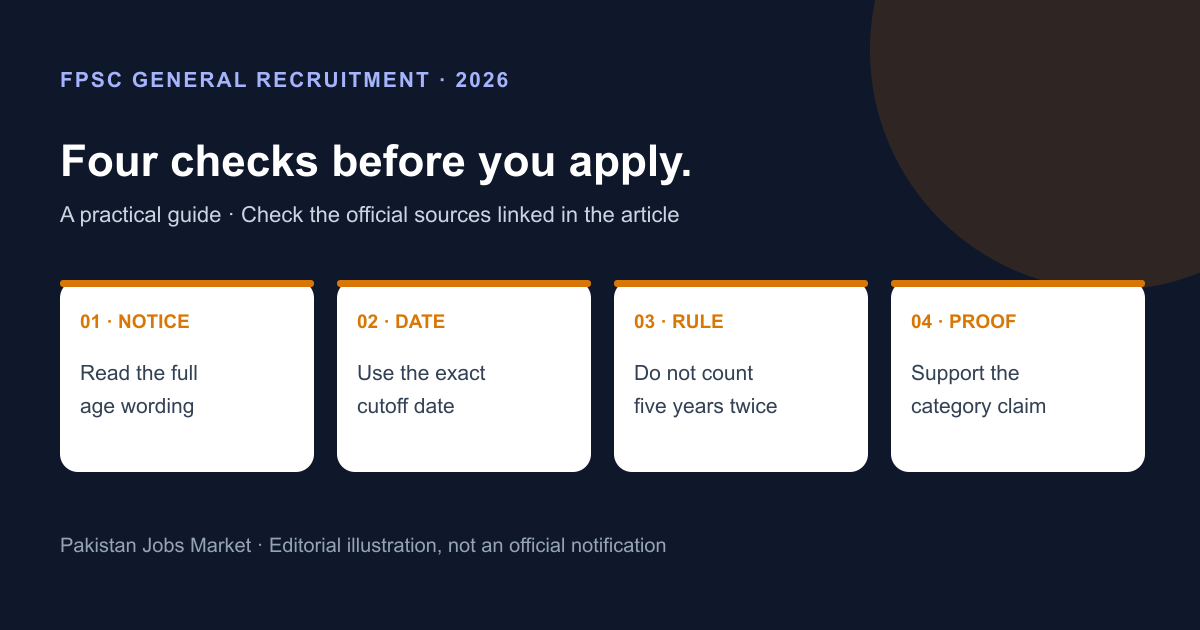
FPSC age relaxation 2026 starts with the upper age limit in the particular advertisement. General recruitment instructions provide five years of general upper-age relaxation, with specified additional categories subject to their conditions. Do not add the same five years twice if the advertisement already includes it. Eligibility depends on the prescribed cutoff date and documentary evidence, not your age on the day you happen to fill in the application.
The most common mistake is to remember one number and use it for every vacancy. A post with a different prescribed upper limit, a special recruitment rule or a different examination framework needs its own check. This article gives a practical method for reading the advertisement, distinguishing general and category-based relaxation, and preparing the evidence that supports a claim. It does not override FPSC's decision on an individual application.
Start with the correct recruitment route
FPSC handles different processes. The general recruitment instructions should not be imported into CSS merely because the same commission conducts both. CSS has its own rules, age provisions and cutoff framework. Provincial commissions and other recruiting organizations also need their own instructions. A search result containing the words government job and age relaxation is not enough to identify the applicable rule.
Find the case number and post title on the original advertisement. Save the advertisement and check for amendments. Then open the instructions linked by the commission for that recruitment route. The FPSC Instructions to Candidates section is the appropriate starting point for the current general instructions. FPSC has moved older document URLs, so use the official information section if an old direct PDF link no longer opens.
Write the recruitment route at the top of your notes. This prevents an easy error when applying to several organizations in the same week. Keep separate entries for each case even if the qualifications look similar. One advertisement may use a different age range or closing date, and a rule you correctly applied to the first application may not settle the second.
Five-year general relaxation: avoid double counting
An advertisement may describe an age range followed by five years of general relaxation. Read the entire line. If the prescribed upper age is thirty and the notice expressly adds five years, the simple illustrative ceiling is thirty-five before considering any other applicable category. If a notice instead states that the displayed limit already includes relaxation, adding five again would be a mistake.
For example, imagine two hypothetical notices. Notice A says “upper age thirty years, plus five years general relaxation.” Notice B says “upper age thirty-five years, including general relaxation.” Those phrases can describe the same general ceiling. Treating both as “displayed number plus five” would turn the second into forty without authority. The wording, not the largest visible number, controls the calculation.
Do not confuse upper-age relaxation with permission to ignore a minimum age. They are different requirements. Likewise, an age concession does not waive a qualification, experience, domicile or registration requirement. A candidate may meet the relaxed age ceiling and still fail another eligibility condition. Check each condition separately rather than treating relaxation as a general exemption from the advertisement.
Categories mentioned in the general instructions
| Category | Instruction to check | Key caution |
|---|---|---|
| Specified communities and areas | Three-year category provision | Only the defined category and required residence evidence qualify |
| Qualifying government service | Ten-year provision, with the stated age cap and continuous-service condition | A public-sector employer is not automatically qualifying government service |
| Retired or released armed forces personnel | Fifteen years or actual service, whichever is less | Service duration and release documents must support the claim |
| Specified family of a federal civil servant who died in service | Five-year category provision | Relationship and death-in-service conditions matter |
The general instructions describe specified Scheduled Caste, Buddhist, recognized tribal-area, Azad Kashmir and Gilgit-Baltistan categories, along with evidence requirements. They also explain that where more than one special category is available, one category is used rather than stacking every concession. The general five-year provision is described separately. Check the exact current text and the advertisement before applying any combination.
The legal framework is the Initial Appointment to Civil Posts (Relaxation of Upper Age Limit) Rules, 1993, as amended. Consult the Establishment Division for the governing rules and FPSC for their application to the recruitment case. This summary intentionally does not manufacture one universal maximum age for all candidates: a category's cap and the prescribed post limit still need to be read together.
Government employees: service history matters
The general instructions specify a ten-year concession up to the stated maximum age of fifty-five for qualifying in-service government servants, including qualifying contract employees, with two years of continuous government service by the closing date. They also list exclusions, including nationalized banks, the State Bank, WAPDA and other semi-government or autonomous bodies. Do not assume that receiving a salary from a publicly owned organization is sufficient.
For a practical check, create a timeline showing appointment dates, the employer's legal identity, any contract extensions and any breaks. Ask your administration section to certify the relevant service where required. The title of your post or the fact that your office serves the public does not establish the category. A certificate should describe the service clearly enough for the recruiting authority to assess it.
Be particularly careful near the stated age cap. This article does not infer a higher universal cap by arithmetic alone. If your case depends on combining the general provision with the government-service cap, seek a case-specific written clarification from FPSC before relying on the result. It is better to identify that interpretive issue explicitly than to present a disputed maximum as certain advice.
Use the prescribed cutoff date, not today's date
For the general recruitment context, the closing date is central to the age and service checks described in the instructions. Read the advertisement for the applicable date and any amended closing date. Calculate completed years, months and days from the documented date of birth. Do not round a person who is thirty-five years and several months old down to thirty-five when a precise age limit applies.
As a simple example, someone born on 10 September 1991 turns thirty-five on 10 September 2026. On 9 September 2026, that birthday has not yet occurred. This illustrates why a year-only subtraction can be misleading. The example does not decide whether that person qualifies for a real post; the advertisement's actual date, wording and rules would still need checking.
Use the same date consistently across the application, certificate and your own worksheet. If an extension is announced, retain the official amendment and confirm how the eligibility cutoff is treated. Never infer that every administrative extension changes every eligibility condition. Where the notice is unclear, ask the commission rather than selecting whichever interpretation produces eligibility.
How to prepare evidence for an age-relaxation claim
Start with the documents that establish identity and date of birth, then add the evidence for the specific category claimed. For government service, that may involve a properly issued service record and departmental documentation. For a residence-based category, the prescribed residence or domicile evidence matters. For armed forces service or a death-in-service family category, the relevant official records must support the exact conditions.
Do not submit a large collection of unrelated certificates and hope that the correct claim emerges. Label your evidence by the condition it proves. A small checklist with “requirement,” “supporting document” and “issuing authority” is useful. Keep names, dates and case numbers consistent. Where documents contain a genuine discrepancy, seek correction or guidance through the proper channel rather than editing a scanned document yourself.
Retain the application confirmation and any correspondence. Follow FPSC's instructions on when and how documents are submitted; the stage can differ from what a friend remembers from an earlier recruitment cycle. A candidate's responsibility is to provide truthful information and the required proof, not to rely on an application portal accepting an entry as final confirmation of eligibility.
Why passing a test does not settle eligibility
An examination result and a document-based eligibility decision answer different questions. A candidate can perform well in a test while still needing to establish age, qualification or experience. Prepare the evidence before investing heavily in a recruitment process. That reduces the risk of discovering late that an important certificate is unavailable or a claimed service period does not meet the stated condition.
Use a four-part checklist: age, education, experience and quota or domicile. Mark each part as supported, uncertain or not met. An uncertain item should lead to a focused inquiry, not a guessed answer on the form. The HEC equivalence and education-level guide can help separate qualification level from the exact discipline required by an advertisement.
Be honest about experience dates as well. A period of study is not automatically employment experience, and a job title alone may not demonstrate the required duties. If a post specifies post-qualification experience, record the qualification completion date alongside employment dates. Relaxation in age does not change the meaning of that experience requirement.
Three common application mistakes
Adding every available category together
A candidate may have more than one personal circumstance that sounds relevant, but the general instructions limit the stacking of special categories. Read the combination rule, select the supported category and obtain clarification if necessary. Do not build a maximum age by adding all numbers in a table.
Using another candidate's calculation
A colleague may have a different date of birth, continuous-service record, domicile or appointment status. Their eligibility does not prove yours. Use their experience to identify questions worth asking, not as the authority for your application. Your own documents must establish each claimed condition.
Confusing a portal field with an approval
An online form allowing you to enter a date does not mean the recruiting authority has accepted the claim. Preserve the submitted details and make sure they are truthful. If you notice an error, follow the commission's current correction process rather than assuming it can always be fixed at interview.
A practical pre-application worksheet
Write down the case number, post title, closing date, prescribed age range and wording about general relaxation. Next record your exact date of birth and age on the relevant cutoff. Add the one special category you intend to claim, if any, and identify the supporting document. Finally, list any unresolved question, such as an age-cap interpretation or a break in service.
This worksheet is particularly useful when several advertisements close close together. It prevents accidentally copying a date or age range from one post to another. Save the source advertisement with the worksheet and name the file clearly. If a correction notice appears, update the worksheet and retain both versions so the basis of your final application is traceable.
Once eligibility is clear, use the Resume Builder to organize your qualifications and experience accurately. A polished document cannot compensate for an unsupported eligibility claim, but it can make verified information easier to review. Keep dates and titles consistent with the certificates you would produce if asked.
Frequently asked questions
Does everyone get five extra years beyond the displayed age?
Not necessarily beyond the displayed number. Read whether the advertisement adds general relaxation or already includes it. The same concession must not be counted twice, and the applicable recruitment framework remains important.
Does private-sector experience qualify for government-service relaxation?
Private experience may satisfy a professional experience requirement where the advertisement allows it, but that is different from qualifying government service for an age concession. Do not merge those two tests.
Can I use this guide for CSS?
No. CSS has separate rules and a separate age framework. Consult the official CSS rules for the relevant examination year. The general recruitment five-year provision should not be imported automatically.
Is being one day over the applicable limit harmless?
Do not assume so. Age requirements use the prescribed cutoff and exact dates. Seek an official clarification if the date calculation is uncertain rather than rounding your age or changing the date entered.
Who gives the final answer on my eligibility?
The recruiting authority applies the governing rules to your case. This article is a preparation aid. For a disputed or unusual situation, provide the precise case number and facts to FPSC through its official contact process.
Sources and scope
This guide draws on FPSC's general instructions, including the version indexed as updated on 13 February 2026, and the Establishment Division's age-relaxation framework. Use the current instructions through the official FPSC information section linked above because older media URLs have moved. Before applying, also check the original notice through FPSC's official website. The examples and worksheet are editorial aids, not new exemptions or a guarantee that a candidature will be accepted.